




If you speak more than one language and work, or want to work in customer support, you have probably asked yourself this question at least once over the past year: is artificial intelligence going to take over multilingual customer service jobs?
Every time a new translation tool or smart chatbot launches, headlines predict that human support agents will disappear. At the same time, if you scroll through international job boards, companies across Europe are still actively hiring thousands of German, French, Dutch, Nordic, Italian and Spanish speakers for customer support roles. So what is actually happening behind the scenes?
The short answer is no, AI is not replacing multilingual customer service agents. Instead, it is changing what the job looks like every day. Routine, repetitive questions are increasingly handled by automated systems, while human agents are being hired for complex problem-solving, emotional intelligence, cultural nuance and customer retention.
For candidates, this shift is actually good news: multilingual roles are becoming less robotic and more focused on real communication. For HR managers and recruiters, it means updating job descriptions, rethinking language tests, and hiring people who know how to work alongside AI tools rather than competing against them.
In this guide we look at what AI can and cannot do in multilingual support, which skills matter most in 2027 and how both job seekers and HR teams can stay ahead.

Will AI completely replace human customer service agents?
No. While artificial intelligence handles simple, repetitive tickets faster than ever, full automation has clear limits when real customers deal with real problems.
Most international companies use a hybrid model. When a customer asks a basic question, such as tracking a delivery, resetting a password, or checking a return policy, an AI chatbot or automated translation tool answers in seconds. That saves time for everyone.
However, the moment a situation becomes emotional, urgent, or slightly unusual, customers want to talk to a real human being who speaks their language naturally. Think about a traveler stranded at an airport after a canceled flight, a business client dealing with a billing error, or a patient calling about a medical insurance claim. In those moments, automated replies often create frustration instead of solving the issue.
If you are looking for international roles where human communication still comes first, you can explore open multilingual customer service jobs on Europe Language Jobs and filter by your native or fluent languages.

What customer support tasks is AI actually taking over?
To understand where human agents fit in, it helps to look honestly at the tasks AI already does well. Understanding this makes it easier for candidates to highlight the right skills on their CV, and helps HR teams define realistic role expectations.
Answering repetitive tier-1 questions
Basic inquiries make up a large percentage of daily support volume. AI assistants easily handle order status checks, store opening hours, basic troubleshooting steps, and standard FAQ responses across dozens of languages at once.
Real-time draft translation for simple tickets
Many helpdesk platforms now include built-in translation plugins. For straightforward written messages, an agent who speaks English can sometimes read and reply to a basic ticket in another language using machine translation. That said, companies quickly notice that machine translation struggles with tone, slang, and industry-specific terms, which is why native and fluent speakers remain essential for brand reputation.
Ticket routing and call summaries
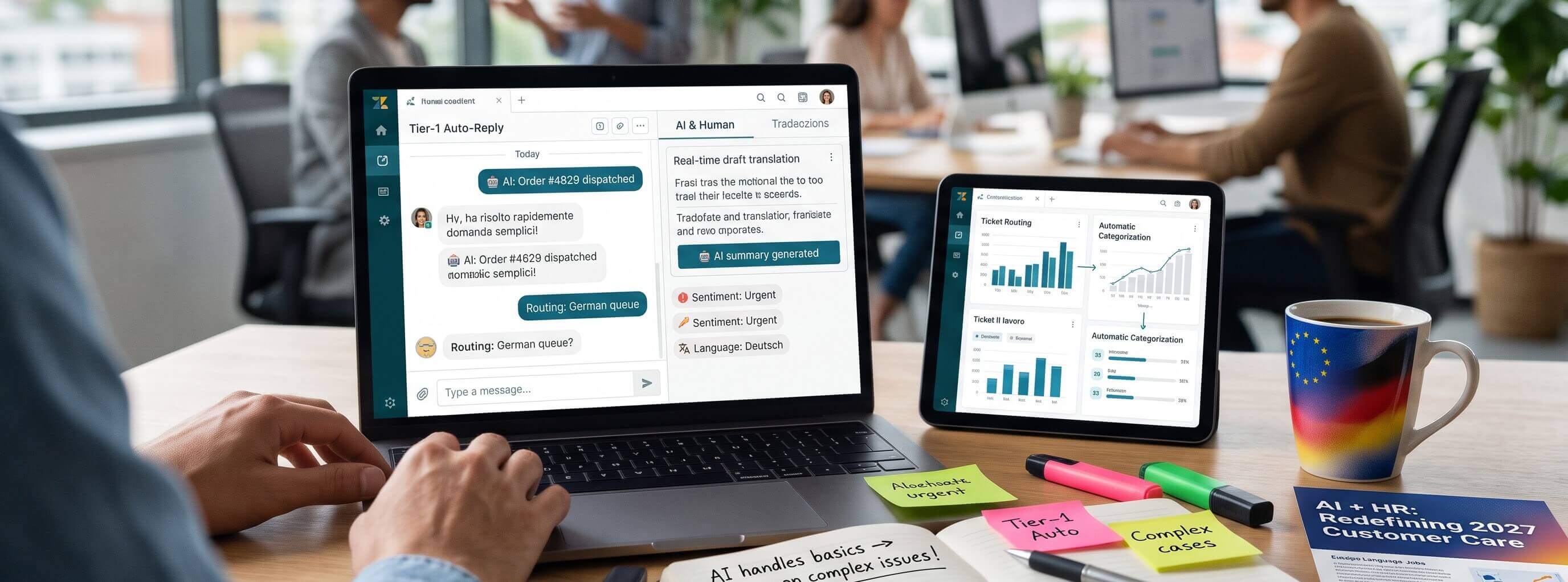
Behind the scenes, AI saves support agents hours of administrative work. Automated tools categorize incoming emails by urgency, detect customer sentiment, route tickets to the right language queue, and generate quick summaries after a phone call ends.
HR insight: When writing job ads for 2027, avoid copying old descriptions focused only on "answering basic emails." Candidates are much more motivated when they see that repetitive admin work is automated and that their role focuses on higher-value customer care and problem-solving.
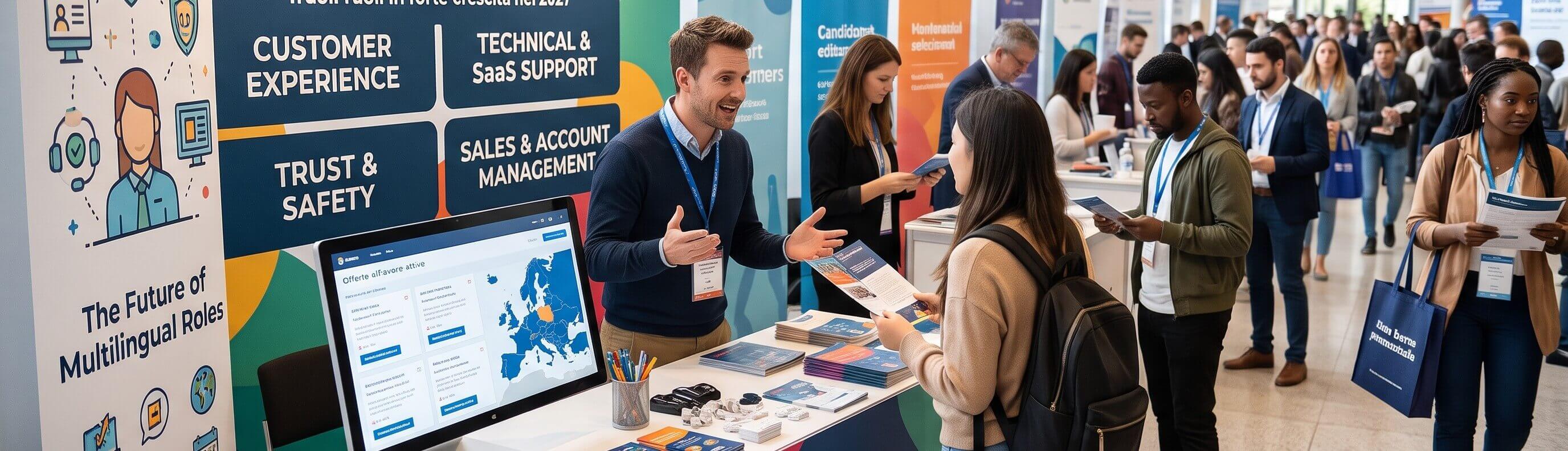
Why do companies still need native and fluent multilingual speakers
If translation software is so advanced, why do international hubs in Lisbon, Barcelona, Athens, Dublin, Krakow, and Sofia keep recruiting multilingual staff? The answer comes down to four things technology still cannot replicate.
Cultural nuance and natural tone
Language is never just vocabulary and grammar, it is culture, politeness, humor, and context. A direct machine translation from English into German, French, or Japanese can easily sound rude, overly formal, or confusing. Native and C1/C2-level speakers know instinctively how to adjust their tone depending on whether they are speaking to an upset customer, an elderly client, or a corporate partner.
Empathy and de-escalation
When customers reach out to human support today, it is usually because the chatbot could not help them. That means the person on the other end of the line is already impatient or stressed. A human agent can listen actively, acknowledge frustration genuinely, and calm the situation down. Empathy builds trust, and trust keeps customers loyal to a brand.
Complex problem-solving across teams
Real customer issues rarely fit neatly into a script. Resolving a complicated refund, coordinating a lost shipment across two countries, or investigating a technical bug requires critical thinking and communication with logistics, finance, or IT teams. AI can suggest answers, but humans make judgment calls.
Brand protection and customer retention
In competitive industries like fintech, travel, e-commerce, and SaaS, customer service is one of the biggest reasons people stay with or leave a company. One bad automated interaction can cost a business a long-term client, whereas a helpful conversation with a skilled multilingual specialist turns a frustrated user into a loyal advocate.
HR insight: Retention of multilingual staff is often more expensive to fix than initial hiring. Companies that position their customer support teams as "Customer Experience Specialists" rather than "call center agents" attract stronger applicants and reduce early turnover.

Which multilingual support roles are growing in 2027?
Instead of shrinking, the multilingual job market is evolving into more specialized roles. Here are the main types of positions seeing strong demand across Europe right now.
Customer experience and retention specialists
-
What the role involves: Handling escalated cases, guiding high-value users, collecting product feedback, and preventing subscription cancellations.
-
Why AI cannot replace it: Keeping a customer who wants to cancel requires persuasion, active listening, and tailored solutions.
-
Best fit for: Empathetic communicators with strong problem-solving skills and native or near-native fluency in their target market language.
Technical and SaaS support agents
-
What the role involves: Helping business users or consumers navigate software platforms, software integrations, hardware setups, or account security issues.
-
Why AI cannot replace it: Technical troubleshooting requires asking the right diagnostic questions, reproducing bugs, and explaining complex steps in simple, reassuring language.
-
Best fit for: Curious, analytical candidates who enjoy technology and want a stepping stone into IT, product management, or operations.
Trust, safety and content moderation specialists
-
What the role involves: Reviewing user-generated content, investigating fraud alerts, verifying business accounts, and protecting online communities from scams or harmful material.
-
Why AI cannot replace it: Automated filters flag suspicious patterns, but human reviewers are needed to understand local slang, cultural context, and gray-area policy decisions.
-
Best fit for: Detail-oriented candidates with strong ethical judgment and deep cultural familiarity with their language region.
Multilingual sales development and account management
-
What the role involves: Qualifying incoming leads, conducting product demos, onboarding new business clients, and managing ongoing B2B relationships in specific European markets.
-
Why AI cannot replace it: People buy from people, especially in B2B markets where cultural rapport and local business etiquette decide whether a deal closes.
-
Best fit for: Goal-oriented communicators looking for higher earning potential through commissions and clear career progression.
If you want to compare salaries, locations, and language requirements across these categories, check out the current customer service and sales jobs abroad available on Europe Language Jobs.
What skills do multilingual candidates need to stand out in 2027?
Speaking two or three languages is still your biggest advantage, but in an AI-assisted workplace, employers look for a slightly broader mix of skills. Highlighting these abilities on your CV and during interviews will put you ahead of other applicants.
AI literacy and prompt comfort
You do not need to be a programmer, but showing that you are comfortable using AI tools in your daily workflow is a huge plus. Mention if you have experience working with CRM platforms, AI-assisted knowledge bases, or ticket-summarizing tools. Employers love candidates who use technology to work faster while keeping human quality high.
Emotional intelligence and active listening
Because human agents now handle the trickiest customer cases, soft skills matter more than ever. Be ready to share real examples in interviews of how you calmed down an upset client, resolved a miscommunication, or adapted your communication style to help someone.
Clear written and spoken communication
In hybrid support centers, you might switch between live chat, email, and phone calls during the same shift. Writing clearly, concisely, and without relying on robotic templates shows recruiters that you can represent their brand professionally.
Adaptability and cross-cultural teamwork
Multilingual hubs in cities like Barcelona, Lisbon, Dublin, and Athens bring together colleagues from dozens of countries. Showing that you enjoy working in diverse international teams, and can adapt quickly when company tools or policies update, makes you a safe, reliable hire.
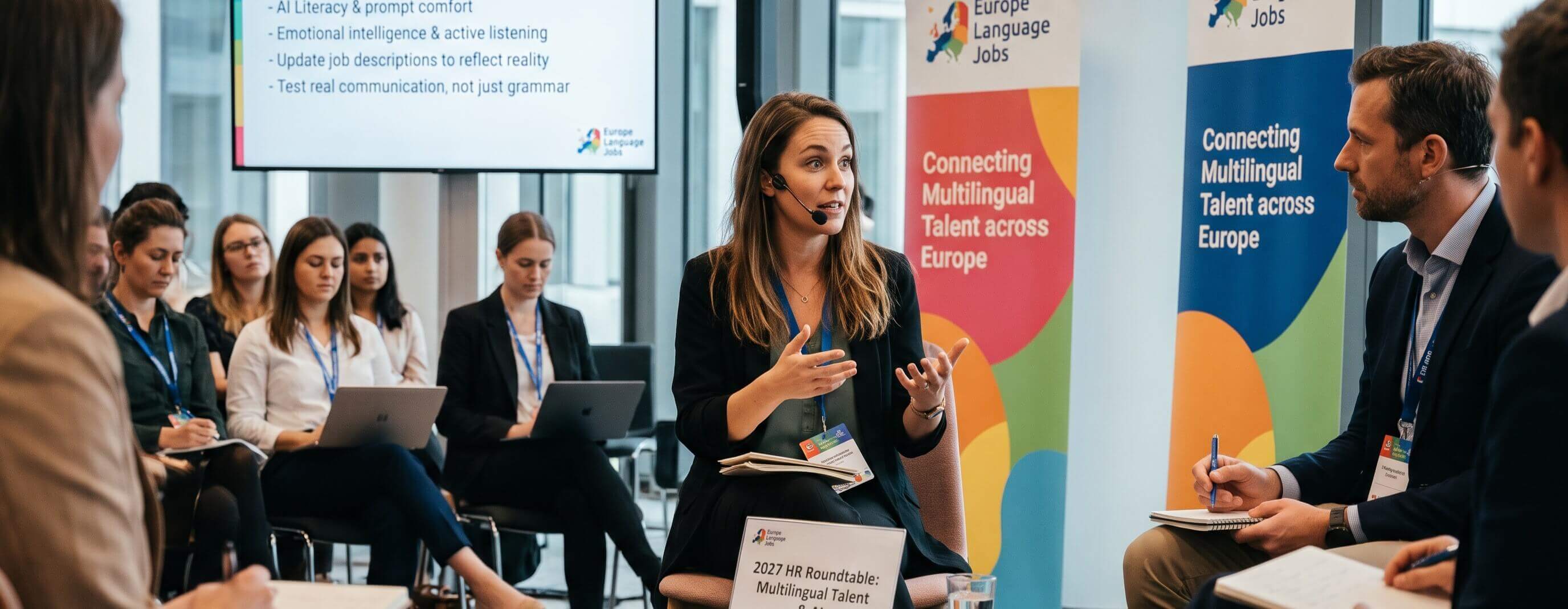
How should HR managers adapt multilingual recruiting for the AI era?
For talent acquisition managers and HR teams, the rise of AI creates both an opportunity and a challenge. On one hand, automated screening and AI tools make sourcing faster. On the other hand, candidates are skeptical of overly automated hiring processes and want to know what their real day-to-day job will look like.
Update your job descriptions to reflect reality
If your team uses AI chatbots to filter out basic FAQs, say so in your job posting. Candidates appreciate knowing they will spend their shifts solving meaningful problems rather than repeating the same three answers all day. Clear, honest descriptions also attract more motivated, career-minded applicants.
Keep the human touch in your recruitment process
Using AI to screen CVs or schedule interviews saves HR teams valuable time, but relying completely on automated video interviews for language roles often backfires. Strong multilingual candidates want to speak with a real recruiter or team lead to ask questions about relocation, team culture, and career growth. Balancing tech efficiency with personal contact improves your offer-acceptance rate.
Test real communication, not just grammar
Traditional multiple-choice language tests rarely show how a candidate will perform on a live support call. Short role-play scenarios, such as replying to a frustrated customer email or explaining a policy change, give hiring managers a much clearer picture of tone, empathy, and cultural fluency.
Invest in internal career paths
One of the biggest fears candidates have about entry-level customer support is getting stuck in the same role forever. When HR teams highlight clear progression paths—into quality assurance, team leadership, training, content operations, or account management—they attract ambitious multilingual talent who stay longer.
If your company is looking to hire skilled multilingual specialists across Europe, you can post a job on Europe Language Jobs to connect directly with international candidates ready to relocate or work remotely.
How can candidates prepare their CV for multilingual support roles?
If you are updating your CV to apply for multilingual jobs in 2027, keep these practical adjustments in mind:
-
Specify your exact language levels clearly: Use the CEFR scale (such as Native, C2, C1, or B2) for every language you speak, and separate spoken fluency from written proficiency if needed.
-
Highlight problem-solving achievements, not just duties: Instead of writing "Answered customer emails," write "Resolved an average of 45 daily customer inquiries in German and English with a 96% satisfaction score."
-
Include tech and CRM tools: List any helpdesk software, CRM platforms, or AI productivity tools you have used—such as Zendesk, Salesforce, HubSpot, or Intercom.
-
Show international adaptability: Studying abroad, volunteering, working in tourism, or living in another country all prove that you can handle cultural differences and relocate smoothly.
Once your CV is ready, create a free profile and start applying directly to multilingual jobs in Europe that match your language combination and preferred destination.
Frequent doubts about AI and multilingual customer service
Will AI make learning foreign languages useless for jobs?
Not at all. In fact, as basic translation becomes automated, companies value genuine human fluency and cultural understanding even more. Speakers of German, Dutch, French, Swedish, Norwegian, Danish, Finnish, and Italian remain among the most sought-after profiles in European business hubs.
Are entry-level multilingual customer service jobs disappearing?
No, entry-level roles are still widely available, especially in travel, e-commerce, fintech, and gaming. However, onboarding now includes training on how to use AI support tools alongside traditional communication skills.
Which European cities hire the most multilingual support agents?
Major international hubs include Barcelona, Madrid, Lisbon, Porto, Dublin, Athens, Thessaloniki, Sofia, Krakow, Warsaw, Prague, and Malta. Many companies also offer hybrid or remote contracts within the same country.
How can HR teams reduce turnover in multilingual customer support?
The most effective strategies include transparent salary and relocation packages, realistic job descriptions, hybrid work flexibility, ongoing coaching, and clear internal promotion opportunities within the first 12 months.
What should candidates ask during a multilingual customer service interview?
Ask how the team uses AI tools in daily workflows, what percentage of inquiries are handled by automation versus human agents, what training is provided during the first month, and what career progression looks like after six to twelve months.