




The Nordic countries - Denmark, Sweden, Norway, Finland, and Iceland - are known for their strong labour markets and high working standards.
Hiring Nordic candidates for roles in Spain, Portugal or Greece can feel challenging, especially when local expectations don’t align with what these professionals are used to. This is why understanding how to recruit Nordic talent abroad properly is essential.
Nordic candidates from Sweden, Denmark, Norway, Finland and Iceland are used to high standards when it comes to salary, transparency, work-life balance and recruitment processes. This is where many companies struggle when trying to recruit Nordic talent abroad: not because of talent shortages, but because expectations are not aligned.
In this guide, we break down salaries, work culture and hiring practices across the Nordic region to help you attract and convert top candidates.
How to Attract Nordic Candidates to Jobs in Southern Europe
Attracting Nordic talent to Southern Europe requires more than simply posting a job offer. Candidates from Sweden, Denmark, Norway, Finland and Iceland are used to high standards, and moving abroad is a decision they evaluate carefully.
Salary remains an important factor, but it is not the only one. Lifestyle, career growth, relocation support and overall job transparency all play a key role in the decision-making process.
For many Nordic professionals, Southern Europe offers an attractive lifestyle, better weather and new international experiences. However, these benefits must be clearly communicated and balanced with realistic salary expectations and working conditions.
For employers in Southern Europe, success depends on how clearly and convincingly this value is communicated from the very first interaction.
Why Nordic Candidates Have High Expectations (And What This Means for Employers)
To successfully recruit Nordic talent abroad, it’s important to understand the environment these candidates are coming from.
Across Denmark, Sweden, Norway, Finland and Iceland, labour markets are stable, well-organized and highly competitive. Candidates are used to strong social systems, high employment standards and recruitment processes that are efficient, transparent and clearly structured.
This directly shapes how they evaluate job opportunities, especially when considering roles in Southern Europe or abroad in general.
For employers in Spain, Portugal and Greece, this means that attracting Nordic candidates is not just about offering a job abroad. It’s about matching the level of clarity, professionalism and efficiency they are used to in their home markets.
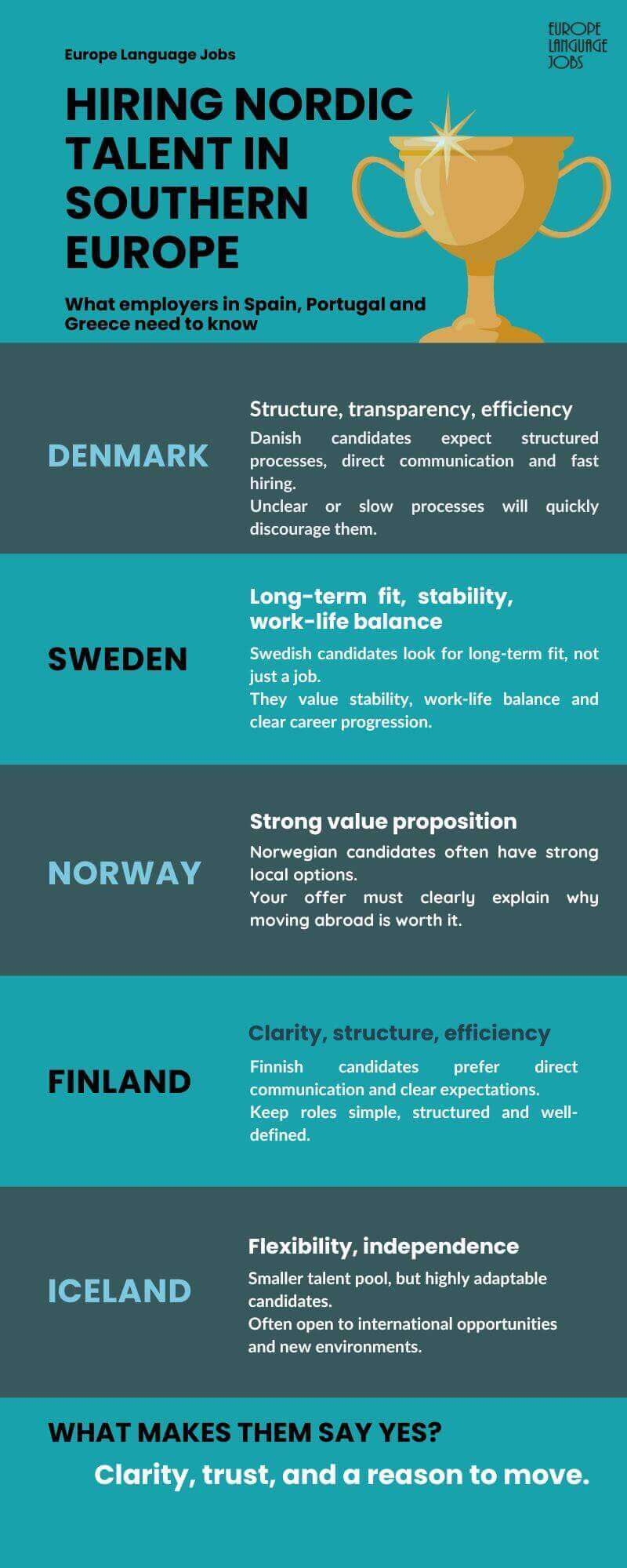
If your hiring process feels slow, unclear or unstructured, it will stand out immediately, and often lead candidates to disengage before the process is even completed.
-
What Danish Candidates Expect When Working Abroad
Denmark creates a highly dynamic but stable environment, where candidates are used to both mobility and protection.
For companies hiring Danish speakers in Spain or Portugal, what you need to understand is that Danish professionals tend to approach new opportunities with a clear expectation of structure, transparency, and efficiency, both in the role itself and in the hiring process.
Minimum wage
In Denmark, there is no official minimum wage set by the government. Instead, salaries are determined through collective bargaining between employers and trade unions. Because this system covers around 82% of workers, most employees are still protected by agreed wage standards (EURES Denmark)
In practice, this results in relatively high earnings. In 2023, the average gross monthly salary was €5,459, with a net salary of around €3,494, both significantly above the EU average (€3,417 gross and €2,351 net).
Working conditions:
-
Average: 37 hours/week
Taxes:
-
Income tax typically ranges between 35–52% depending on income level (EURES Denmark)
Cost of living:
-
Among the highest in Europe, especially in Copenhagen
Talent availability: High demand for skilled professionals, particularly in technical roles; limited surplus talent (EURES Denmark)
For employers, this means that unclear job offers, vague communication, or slow hiring processes can quickly discourage candidates, even if the role itself is attractive.
-
What Swedish Candidates Look for in Jobs Abroad
Sweden’s labour market shares many similarities with Denmark, but places an even stronger emphasis on skills development and long-term alignment between candidates and roles. This focus influences how professionals assess opportunities, they are not just looking for a job, they are looking for a role that fits their expertise and future goals.
Minimum wage:
In Sweden, there is no government-set minimum wage. Instead, salaries are established through collective bargaining between employers and trade unions. With around 88% of workers covered by these agreements, most employees benefit from structured and regulated wage levels (OECD-ICTWSS).
In 2023, the average gross monthly salary was €3,715, with a net salary of approximately €2,827, both slightly above the EU average (€3,417 gross and €2,351 net). However, wage growth in Sweden has been more moderate in recent years compared to the EU overall.
Working conditions:
-
Around 40 hours per week, with a strong emphasis on work-life balance (EURES Sweden)
Taxes:
-
Approximately 29% to 35%, depending on income and municipality. Sweden's average local tax rate is around 32%. Earners above a certain income threshold set by the Tax Agency (link in Swedish) pay an additional 20 per cent state tax.
Cost of living:
-
High, particularly in major cities like Stockholm
Talent availability: Ongoing skills mismatch; improving job matching remains a priority (OECD Sweden 2025)
When trying to recruit Swedish speakers abroad, employers should focus on presenting roles that clearly match candidates’ skills and offer long-term stability, rather than short-term or poorly defined opportunities.
-
How to Attract Norwegian Candidates to International Roles
Norway’s economic strength and high standard of living play a major role in shaping candidate behavior. With strong job creation and relatively low unemployment, many professionals already have access to attractive opportunities locally, which makes them more selective when considering roles abroad.
Minimum wage:
-
No general minimum wage; some sectors regulated through agreements or legislation (EURES Norway)
Working conditions:
-
Around 37.5 hours per week; strong employee protections (EURES Norway)
Taxes:
-
Generally between 22% and 45%, depending on income, having a a pay-as-you-earn (PAYE) system is introduced and in force from 1 January 2019.
Cost of living:
-
Very high, among the highest globally. The cost of living in Norway is pretty expensive, being on the 6th place in the world and on the 3rd place in Europe.
Talent availability:
-
Limited surplus talent; strong labour market with consistent job creation (OECD Norway 2024)
Attracting Norwegian candidates to Southern Europe requires a strong value proposition, combining lifestyle benefits with clear career opportunities. Whether through lifestyle benefits, international experience, or clear career development opportunities.
4. Why Finnish Candidates Are More Open to Working Abroad
Finland remains a highly organized and stable labour market, but recent developments have created slightly different dynamics compared to its Nordic neighbors. A weaker labour market in recent years has made some candidates more open to exploring opportunities abroad.
Minimum wage:
In Finland, there is no statutory minimum wage set by the government. Salaries are instead determined through collective agreements, which play a key role in ensuring fair wage levels across different sectors.
In 2023, the average gross monthly salary was €4,442, with a net salary of around €3,040, both above the EU average (€3,417 gross and €2,351 net). Wage growth in Finland has remained relatively stable in recent years, broadly in line with EU trends.
Working conditions:
-
Working time shall not exceed eight hours a day or 40 hours a week.
Taxes:
-
In Finland, income tax is made up of several components, including a progressive state tax, a flat municipal tax, and social security contributions. As a result, total taxation typically ranges between 30% and 55% depending on income level.
Cost of living:
-
High, but generally lower than Norway and Denmark.
Talent availability: Increased openness due to weaker labour market conditions; some surplus in generalist roles (Bank of Finland, 2025)
For companies hiring Finnish talent abroad, Finland represents one of the most accessible Nordic talent pools at the moment, particularly for entry-level or early-career profiles.
5. Hiring Icelandic Candidates for Jobs Abroad
Hiring Icelandic candidates abroad might feel harder, as Iceland’s labour market is significantly smaller than those of other Nordic countries, but it still shares many of the same structural characteristics. Its size and geographic isolation create unique conditions, particularly in terms of talent availability and cost of living.
Minimum wage:
In Iceland, there is no government-set minimum wage. Instead, salaries are determined through collective bargaining between employers and trade unions. With around 90% of workers covered by these agreements, most employees benefit from clearly defined wage standards (OECD-ICTWSS).
In 2023, the average gross monthly salary reached €6,184, with a net salary of approximately €4,490—both significantly above the EU average (€3,417 gross and €2,351 net). While salaries are high, wage growth in recent years has been more moderate compared to the overall EU trend.
Working conditions:
-
40 hours per week, depending on the sector.
Taxes:
-
Approximately 31% to 46%, depending on the income range.
Cost of living:
-
Very high due to import dependence and geographic isolation
Talent availability: Limited due to small population; demand in sectors such as tourism and services
For employers, Icelandic candidates may be fewer in number, but they are often highly adaptable and open to international environments.
Cultural Differences: What Nordic Candidates Expect When Working in Southern Europe
When trying to recruit Nordic talent abroad, cultural differences often matter more than salary or location.
Across Denmark, Sweden, Norway, Finland and Iceland, workplaces share common characteristics: they are generally flat, structured and built on trust. Employees are used to a high level of independence, clear responsibilities and efficient processes from the very beginning.
In Denmark and Iceland, work environments tend to be informal and flexible, but still rely on strong individual responsibility and self-management. Norway follows a similar model, with workplaces built on trust, minimal hierarchy and a strong emphasis on equality and efficiency rather than status or seniority.
Sweden work culture is more collaborative and consensus-driven, with a strong emphasis on equality, inclusion and structured decision-making. Finland, on the other hand, is typically more reserved and highly organized, with a clear focus on planning, efficiency and direct communication.
Final tips for recruiting Nordic talent abroad
Compared to Southern Europe, these differences become more visible during the hiring process. Nordic candidates are typically used to:
-
transparent job expectations,
-
efficient and predictable recruitment timelines,
-
low hierarchy and direct interaction with managers.
In contrast, hiring processes in Spain, Portugal or Greece can sometimes be more flexible and less structured in comparison. While this works well locally, it can create friction for Nordic candidates who expect clarity and consistency throughout the process.
Small adjustments, such as being more transparent about salary, defining roles more clearly or improving response times can significantly increase your chances of attracting and converting candidates.
Companies that successfully align their hiring approach with Nordic work culture will stand out, gaining a clear competitive advantage when hiring Scandinavian employees for roles in Southern Europe.