




You have a job offer in France, or you are close to one, and the next question is whether you can legally take it. For non-EU nationals, the answer depends on a document your future employer requests on your behalf: the work authorization, known in French as the autorisation de travail.
The rules below cover who needs a French work permit, which route fits which profile, what the employer and the employee each have to prove, and how an application runs from the job ad to your first residence card.
What a work permit in France actually is
A French work permit is an authorization your employer obtains from the préfecture, and on its own it does not let you enter or live in France. It works alongside two other documents:
Two details matter. Some residence permits, such as the Talent card and the EU Blue Card, carry the right to work themselves, so no separate work authorization is needed. And a standard work authorization is tied to one employer, one job and one territory.
Who needs a work permit in France?
Any non-EU national hired by a French employer needs a work authorization, unless they already hold a residence document that includes the right to work. Your nationality decides the first question, and your current permit decides the second.
EU, EEA and Swiss citizens
Citizens of the 27 EU member states, the EEA countries (Iceland, Liechtenstein, Norway) and Switzerland can work in France under the same conditions as French nationals, with no visa and no work authorization.
Since Brexit, UK citizens are third-country nationals and need a work authorization like anyone else. The only carve-out covers UK citizens who lived in France before 2021 and hold the Article 50 TUE residence card, which allows salaried work without any further authorization.
Non-EU nationals: the general rule
If you come from a non-EU country, assume you need a work authorization for any job longer than three months. A short list of activities under three months is exempt, such as speaking at a conference, performing at a cultural event, teaching as a visiting professor or carrying out an IT, audit or engineering expertise mission as a posted employee. Any other short assignment still requires the authorization.
Algerian nationals follow a separate framework set by the 1968 Franco-Algerian agreement, with its own residence certificates and rules.
Residence permits that already let you work
If you already live in France on another status, your permit may cover salaried work. Before any hire, the employer still has to check the permit's authenticity with the préfecture at least two working days before the start date.
A récépissé (the receipt the préfecture issues while your card is processed) only lets you work if it states "autorise son titulaire à travailler". Check that line before your first day. The online deposit confirmation from the ANEF platform never allows work on its own.
Working remotely in France for a foreign employer
If you plan to live in France while working remotely for an employer based abroad, the work authorization route does not apply to you. You are not joining the French labour market, and your employer has no French entity to file anything.
In a recent answer to a parliamentary question, the Minister of the Interior confirmed that remote work from France for a foreign employer counts as non-professional activity under French immigration law. The long-stay visitor visa is the correct status for that profile.
Which French work permit route fits your profile?
Most professionals land on one of three employer-backed routes, and the gross annual salary on the offer usually decides which one. Check the higher-paying routes first: they skip the work authorization entirely.
Standard salaried route: salarié or travailleur temporaire
This is the default route for every job offer that does not qualify for a Talent card. A permanent contract (CDI) leads to a VLS-TS marked salarié; a fixed-term contract (CDD) leads to a VLS-TS marked travailleur temporaire. The employer files the work authorization, then you apply for the visa.
After the first year, if you still hold the same job, you can renew into a multi-year card valid for 4 years.
EU Blue Card
The EU Blue Card is the strongest route for senior and specialist hires, and it is our default recommendation whenever the salary clears the threshold. You need a degree sanctioning at least three years of higher education, or five years of relevant professional experience (three years for certain listed professions), a contract of at least six months and a gross salary of at least €59,373 per year.
Your employer skips the work authorization and the labour market test. Your spouse and minor children qualify for a talent-famille card without going through family reunification, and spouses on that card can work. A contract of two years or more gives a card for the length of the contract, up to four years; a shorter contract gives the contract length plus three months, up to two years.
One practical warning: the threshold applies again at renewal. A move to part-time or a pay cut below €59,373 can cost you the card two years later, so negotiate your package with that number in mind.
Talent qualified employee
This card covers three situations, all with a €39,582 gross annual floor: graduates holding a French master's-level degree, employees of a company recognised as innovative who work on its R&D project, and staff transferred within a group who have at least three months of seniority.
If you studied abroad and your offer sits between €39,582 and €59,373 at a regular company, you are usually on the standard salaried route. Check the innovative company status before you conclude that, because many French startups hold the Jeune Entreprise Innovante (JEI) label.
Recent graduates of French universities
If you finished a master's-level programme in France, the job seeker or business creation card (carte de séjour recherche d'emploi / création d'entreprise) lets you take a job matching your studies without a work authorization, as long as it pays more than €2,800.53 gross per month. Graduates hired within the year of their degree on a matching job at that salary also escape the job-posting requirement.
Working holiday visa
France signs working holiday agreements (visa vacances-travail) with a set list of countries, including Canada, Australia and New Zealand. The visa lets you work without an authorization for its duration, which makes it a useful way to test the French job market before an employer sponsors you. Age limits and quotas depend on the bilateral agreement.
Requirements for a French work authorization
On the standard salaried route, the préfecture assesses the job, the salary and the employer, not your CV alone.
The job: labour market test or shortage occupation
The offer must meet one of two conditions. Either the job appears on the official list of shortage occupations (métiers en tension), or the employer published the vacancy with the public employment service, such as France Travail, for three consecutive weeks within the six months before filing and received no suitable application.
As indicated above, some profiles skip the test entirely: holders of the job seeker card on a matching job paid above €2,800.53 gross per month, and French master's graduates hired in the year of their degree under the same conditions.
Insider tip: tell your future employer to post the ad as soon as the hire looks likely. The three weeks can run while you negotiate the contract, and the posting stays usable for six months.
The salary
Your pay cannot fall below the SMIC (French minimum wage) or, if higher, the minimum set by the collective agreement (convention collective) that covers the company. Préfectures do compare the two, and an offer at SMIC in a sector whose agreement sets a higher floor will be refused. Talent cards add their own thresholds of €39,582 and €59,373.
The employer
The employer, or the French client company in the case of a posting, has to show it is in good standing. Under the rules published by the government, that means:
-
An URSSAF certificate under six months old proving social contributions are paid.
-
No criminal conviction or administrative sanction for illegal work, facilitating irregular stay, breaches of posting rules or forgery.
-
A hiring project in proportion to the company's activity: a two-month-old company with no revenue that recruits a senior engineer can be refused on that ground alone.
-
For regulated professions (lawyers, doctors, architects and similar), proof that you meet the French conditions to practise.
How to apply for a work permit in France, step by step
On the standard route, the employer drives the first half of the process and you drive the second. Here is the order for a candidate living outside France.
-
Confirm the route before anything is filed. If your salary and degree qualify for the EU Blue Card or a Talent card, skip to step 4: no work authorization is needed. Filing a standard work authorization for a Blue Card profile wastes weeks and costs the employer a tax it did not have to pay.
-
The employer publishes the vacancy (if required). Three consecutive weeks with France Travail or another public employment service, unless the job is on the shortage list.
-
The employer files the work authorization online. The application goes through the ANEF platform, whether you live in France or abroad. The préfecture of the département where the company has its head office handles the file.
-
You apply for the long-stay visa. Once the authorization is granted, your employer forwards it and you apply on France Visas, then submit your file at the French consulate or visa centre in your country of residence. The visa fee is €99, plus the visa centre's own service charge.
-
You arrive and start work. With a VLS-TS salarié or travailleur temporaire, you can start working from your arrival date.
-
You validate your visa within three months. Validation happens online on the ANEF platform and costs €300, paid by tax stamp (timbre fiscal). Without it, you are not lawfully resident after the aforementioned three months and cannot re-enter the Schengen area on that visa. The French Office for Immigration and Integration (OFII) then calls most newcomers for a medical check and the sessions of the republican integration contract (contrat d'intégration républicaine, or CIR).
-
You apply for your residence card before the visa expires. File at the latest two months before the VLS-TS end date, with the préfecture of your place of residence.
On the Talent and EU Blue Card routes, steps 2 and 3 disappear. The consulate issues either a VLS-TS marked talent for stays under 12 months, which you validate within three months, or a three-month entry visa for longer stays. In that second case, you apply for your multi-year card on the ANEF platform within two months of arriving.
If the préfecture does not answer a work authorization request within two months, the silence counts as an implicit refusal. You then have two months to file an administrative appeal (recours gracieux to the préfet or recours hiérarchique to the Minister of the Interior) or a claim before the administrative court (tribunal administratif).
Already in France on another valid permit, for example as a student or a visitor? You can usually switch to a work-based permit without leaving the country. The employer still files the work authorization, and you apply for a change of status (changement de statut) with the préfecture. The main exception is the seasonal worker card, which does not allow a change of status.
'Changing jobs, renewing your work permit and staying long term
On the standard route, your right to work follows the authorization. Every new employment contract needs a new work authorization filed by the new employer before you start, even if your residence card still has months to run.
The contract type also has to match the card. A salarié card covers a CDI; if your new authorization is for a CDD, you must switch to a travailleur temporaire card, and the reverse applies too. You can only start the new job once you hold at least a récépissé stating that you may work.
Renewal requests go in at the latest two months before your card expires. Holders of a 4-year multi-year card or a resident card who file on time keep the right to work for up to three months after the expiry date while the préfecture decides. Losing your job is not automatically the end: if you receive unemployment benefits from France Travail, a salarié card can be renewed for one more year.
After five years of legal residence, you can apply for a 10-year resident card, subject to stable income, integration and French language conditions. EU Blue Card holders can also count time spent on a Blue Card in other EU countries toward EU long-term resident status.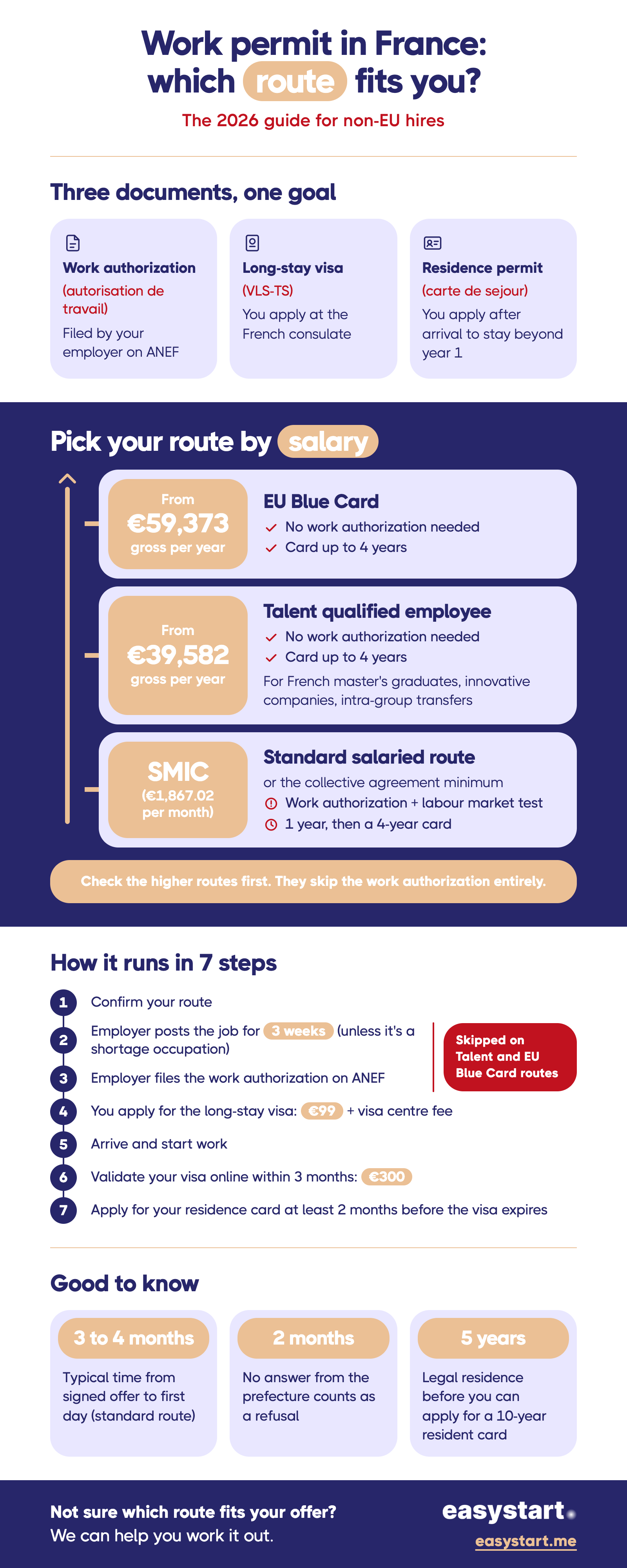
FAQ
Can I apply for a French work permit myself?
No, not on the standard route. The work authorization is always filed by the employer or by a representative it appoints. On the Talent and EU Blue Card routes there is no separate authorization: you apply for the visa yourself, using an employer attestation as part of your file.
I'm a US citizen. Can I come to France as a tourist and find a job?
You can interview and network during a visa-free stay of up to 90 days, but you cannot start working. In most cases you then return home and apply for the long-stay visa at the French consulate in your country of residence once the employer's paperwork is approved. Plan your job search around that return trip.
Do UK citizens need a work permit in France after Brexit?
Yes. UK nationals arriving now follow the same rules as non-EU citizens. Only UK citizens who held French residence before 2021 under the Withdrawal Agreement, and carry the Article 50 TUE card, can work without an authorization.
How long does it take to get a work permit in France?
Count around three to four months from signed offer to first day on the standard route, including up to two months for the work authorization and a few weeks for the visa. EU Blue Card and Talent hires usually move faster because the work authorization step disappears.
Do I need to speak French to get a French work permit?
Not for the work authorization or the first visa. French becomes a condition later: A2 level and a pass in the civic exam are required for your first multi-year card on the salaried route, and a higher level applies to the 10-year resident card and to citizenship.
Can my partner work in France if I get a work permit?
On the Talent and EU Blue Card routes, yes: your spouse receives a talent-famille card, which allows work, without a separate family reunification procedure. On the standard salaried route, your family usually joins you through family reunification (regroupement familial), a separate and longer procedure with its own income and housing conditions.
I'm Canadian or Australian and under 35. Is there a faster option?
Possibly. Both countries have working holiday agreements with France, which let you work without an employer-sponsored authorization for the length of the visa. Age limits and quotas vary by agreement, so check the current terms on france-visas.gouv.fr before you plan around them.
If you would rather have a specialist handle the file from route choice to residence card, EasyStart manages French work permits and visas for both candidates and employers.
EasyStart is an immigration and relocation consultancy helping individuals, families, entrepreneurs and companies move to France and Spain. They provide personalised guidance throughout the relocation journey, from visa applications and residence permits to settling into your new country. Their goal is to make the process clearer, simpler and less stressful, so you can focus on your next chapter instead of navigating local bureaucracy on your own.