




Living and working in Europe offers incredible opportunities, but navigating international job markets, startup grants, or relocation logistics can be challenging.
While almost everyone knows about Erasmus+, the European Union offers several lesser-known funding initiatives designed to pay for your relocation, sponsor your startup, or kickstart your career abroad.
Whether you are a recent graduate, an aspiring founder, or a skilled professional looking to move across borders, this guide covers the top European programmes and resources you should leverage today.
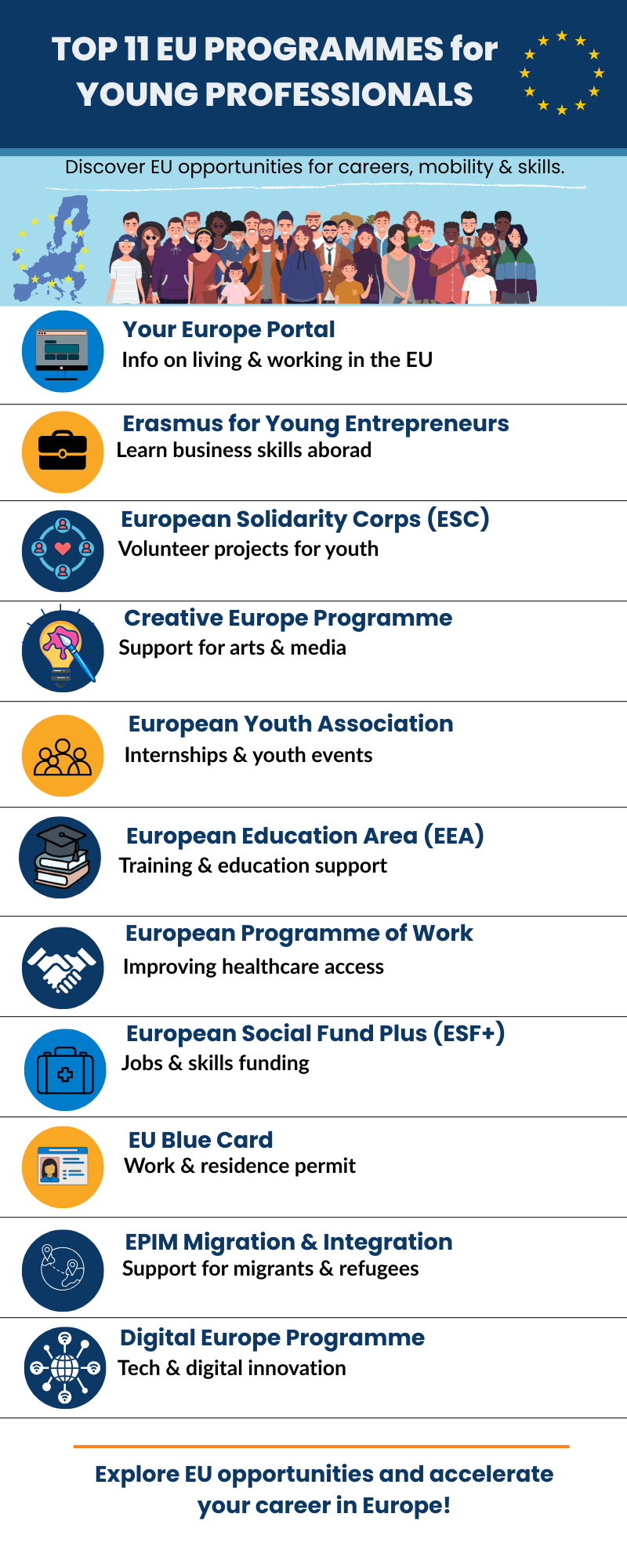
Top European Programmes & Resources for Young Professionals
- Your Europe Portal
- Erasmus for Young Entrepreneurs
- European Solidarity Corps
- Creative Europe Programme
- European Youth Association
- European Education Area (EEA)
- European Programme of Work
- European Social Fund Plus (ESF+)
- EU Blue Card
- European Programme for Integration and Migration (EPIM)
- The Digital Europe Programme (DIGITAL)
Navigating tax laws, healthcare, social security, vehicle registration, and visa procedures when moving to a new country can be daunting.
The Your Europe Portal is an official European Union guide that removes the guesswork by providing verified, practical administrative steps tailored to your specific country of origin and target destination.
-
Best for: Expats, workers, students, and businesses relocating within Europe.
-
Key benefits: Practical step-by-step guides on cross-border employment rights, tax residency, health insurance forms (EHIC/S1), and free assistance services like SOLVIT to resolve administrative hurdles with national authorities.
You may think that it is too late to benefit from the Erasmus programme if you have already graduated.
That’s not true!
Erasmus is not just for university students. Erasmus for Young Entrepreneurs is a cross-border exchange programme that gives new or aspiring founders the chance to work alongside experienced business owners in another participating country for a period of 1 to 6 months.
-
Best for: Aspiring entrepreneurs or founders who have launched a business within the last 3 years (no age limit).
-
Key financial benefits: A monthly EU financial grant ranging between €560 and €1,100 (depending on the cost of living in the host country) to cover accommodation and travel expenses, combined with hands-on mentorship from an established CEO.
-
How to apply: Submit an application along with a structured business plan through the official Erasmus for Young Entrepreneurs portal and select an Intermediary Organisation (IO) in your home country.
For young adults eager to build international experience while creating a positive social impact, the European Solidarity Corps is the primary EU funding scheme for fully funded volunteering, local solidarity projects, and humanitarian initiatives across Europe and partner countries.
-
Best for: Young adults aged 18 to 30 (and up to 35 for Humanitarian Aid Volunteering projects).
-
Key financial benefits: Fully funded international placements where accommodation, food, pocket money (approx. €5–€6/day depending on the country), comprehensive Henner health insurance, and round-trip travel costs are covered by the EU grant.
-
How to apply: Register on the European Youth Portal, complete your profile, and apply directly for open volunteering opportunities.
This European programme is dedicated to aspiring artists and creatives. The 3 primary pillars embrace culture, media, and a cross-sectoral strand. The European Commission provides funding for these sectors, striving to make them more inclusive, more digitally advanced, and more sustainable.
There is also a mobility scheme for artists and creatives available within the Creative Europe Programme for 2021-2027, so make sure to consult the official website for more information on how you can benefit as a creative.
This portal operates in 3 main areas:
-
Providing information and opportunities for young Europeans
-
Promoting the UN Sustainable Development Goals (SDGs) and Agenda 2030
-
Empowering young people to make a positive difference
You can access the European Youth Association portal to browse opportunities for volunteer work, internships, scholarships, and events. The association also shares the latest news about interesting things happening in the area of youth empowerment in Europe.
They also organise major global events, such as the Young Leaders Programme or the World Youth Development Forum. You can join as an Ambassador to get access to the full scope of opportunities offered by the European Youth Association.
Education and professional training are the key areas of career development. In order to facilitate this process, the European Commission established the European Education Area.
The goal of EEA is to facilitate collaboration across the EU member states to improve the education and training systems. They believe that everyone in Europe should have equal access to development opportunities, regardless of their background, so they focuses on making diploma recognition, skill certification, and cross-border adult learning seamless across all member states.
You can navigate the website in 2 ways: by selecting education levels or particular focus topics. The EEA also encompasses training and education for adults, so it is a great resource for young professionals in Europe.
Contrary to what the name may suggest, this European programme is not directly related to work aid. Also known as the United Action for Better Health in Europe, it is a WHO project meant to improve the quality of access to medical care.
It is not a uniquely EU-wide project, but the WHO does achieve its goals through a dialogue with the EU member states. It is no secret that in order to work efficiently, we need to be healthy, so we thought mentioning the European Programme of Work is crucial.
What’s more, the discrepancies between the access and length of sick and parental leave in different European countries continue to be an issue, and a programme like this one is an ideal initiative to address them.
While the first phase concluded (2021–2025), the Second European Programme of Work (2026–2030) is now active. This updated edition places an even stronger focus on digital health solutions, workplace mental well-being, and bridging healthcare gaps for mobile and remote workers across Europe.
Although an individual professional doesn’t directly interact with money from the European Social Fund Plus, we can all benefit from it in different ways. It is not money we receive from the government, but funding that the European Commission provides for every EU member state.
How does it work? Each European country is allocated a certain budget, and the government decides internally how to allocate it. However, the European Commission supervises the process, making sure all of the money is used appropriately.
What can it be used for?
-
Job-matching services
-
Professional training
-
Career advisory
-
Support for employers to train workers
So, if you attend a free skill workshop or a session with a career coach in your area, it may have been funded by ESF+. Additionally, the fund pays special focus to young professionals. The Youth Employment Initiative (YEI) supports people under 30 in their search for their first job, especially in countries with high young unemployment rates.
The European Social Fund Plus also operates in other social areas, but we focused primarily on employment here. If you are curious how else the fund can help you, make sure to visit its official website.
You can also access the full list of funding provided by the EU if the topic interests you.
The Blue Card is the European counterpart of the US Green Card. It combines a work and residence permit for non-EU residents wanting to move to Europe. A candidate for the EU Blue Card needs to fulfil 3 conditions in order to obtain it:
-
Be a non-EU citizen
-
Holding a higher education degree (at least a 3-year bachelor's) or 5 years of equivalent professional experience in a relevant sector.
-
Have an employment contract or a binding employment offer
Having the Blue Card simplifies access to many services in the EU, as well as facilitates certain processes such as renting a house or creating a bank account.
The EPIM combines more than 25 European foundations surveilled by the Network of European Foundations (NEF). This programme is particularly interesting for expats and those wanting to work abroad in Europe.
The European Programme for Integration and Migration does not have a direct impact on the actions of individual governments in EU member states, but it does closely collaborate with organisations working with migrants and refugees.
It focuses more on emphasising the impact of civil society in the process of advocating a more constructive approach to migration within Europe. It bridges the gap between NGOs, policymakers, stakeholders, and the public, develops communication strategies, provides funding, and conducts research regarding migration procedures and policies, both on the national and EU-wide level.
The Digital Europe Programme strives to increase the level of technological advancement in Europe. It provides funding for digital transformation for businesses and public administration across the EU member states.
It connects to employment in a way that businesses can profit from funding for more advanced technological equipment, increasing efficiency and the comfort of work. The money can also be used to sponsor training in the areas of Artificial Intelligence, digital skills, and cybersecurity - all of these aspects are crucial in everyday employment, regardless of the profession.
The DIGITAL aid for public administration can also translate to higher productivity and better workflow management at public offices. This, in turn, can result in shorter waiting times for documents such as work permits or social security numbers, necessary to find a job abroad.
What is Europe Day?
This year marks the 76th anniversary of the Schuman Declaration, the historic proposal that laid the foundation for the creation of the European Union.
On May 9, 1950, the French Foreign Minister, Robert Schuman, proposed uniting coal and steel production across European nations to make war between them not only unthinkable, but materially impossible following the Second World War.
To commemorate this milestone, the 9th of May is celebrated every year as Europe Day. It stands as a celebration of solidarity, unity, and long-term peace, serving as an opportunity to promote shared European identity and values.
Around May 9th each year, key European institutions, such as the European Parliament, European Council, and European Central Bank, host open days during the week. You can use this opportunity to explore the buildings where some of the most important decisions for the EU are made.
The European programmes and resources encompass various areas, from training and digitalisation to migration aid and volunteering opportunities. Everyone can find something useful, you just need to know where to look.
Celebrate this Europe Day by discovering the range of various programmes and resources for young professionals you have at your disposal. Some of them have age restrictions, so make sure to benefit from them before it’s too late!
Ready to start your international journey?
Create your candidate profile on